Saudi Arabia is implementing ambitious national transformation programs that can succeed only if they reach key social, economic, and environmental objectives. Traditional policy making, incentives, rules, and regulations alone will not be enough to achieve many of these objectives. This is because people have “cognitive biases,” natural tendencies to resist change, even against their best interests. To counter such biases and improve the efficiency of new policies, many countries are integrating behavioral insights into the policymaking process.
Behavioral science can provide policy makers with a better understanding of why people behave in these ways and help them design tools to change these behaviors, there by enriching the economic models in place.
According to Strategy&, behavioral interventions could possibly be applied to 12objectives in these plans considering structural levers used to achieve them, as well as the success of behavioral interventions implemented globally to achieve similar objectives.
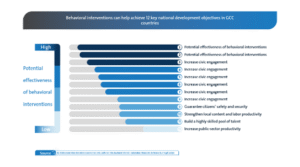
By applying behavioral interventions in the right places, the country can effectively achieve the key objectives outlined in their national transformation plans.
Behavioral tools should be transparent and not misleading, back out, and should aim to improve people’s welfare. 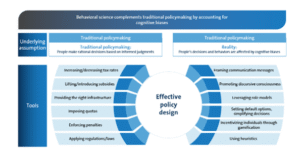
The most common examples include:
- Framing communication messages.
Communication campaigns leveraging deep cultural and psychological insights are key to effectively enabling the desired change.
- Promoting discursive consciousness.
Discursive consciousness is what a person is able to say or articulate verbally about social conditions. Designing interventions in schools (updated curricula, training sessions, field trips) and special content segments on media channels educates audiences on intended behaviors.
- Leveragingrole models.
Selecting brands or public personalities (athletes, artists, and political leaders) or creating model fictitious characters to champion a desired behavior can encourage more people
to follow suit. Similarly, initiating peer comparisons can motivate change by triggering a sense of pride or guilt.
- Setting new default options.
Using regulation to position a desired outcome as the default option (e.g., making a green plan for household electricity consumption the default choice) increases individuals’ participation without restricting their freedom of choice.
- Incentivizing individuals through gamification.
Giving individuals opportunities to earn achievements when they engage in a desired behavior, through personal goalsetting or competitions on social media, for example, boosts their sense of self-efficacy or normalizes the target behavior socially.
- Using heuristics.
Creating mental “shortcuts” like catchphrases, songs, visual cues, and so forth, can speed up people’s decision-making process and help them adopt a satisfactory solution close to the desired behavior (e.g., people easily remember the “a 5 day” recommendation to eat the right amount of fruits and vegetables, although this does not necessarily mean they follow it).
Case studies
The case studies below illustrate framework for the aforementioned behavioral tools:
- Incentivizing individuals through gamification:STC Qitaf Program, KSA
Problem:
The “Commoditization Trap“, where telecom services are seen as a basic utility, leading to high churn rates as customers switch providers for minor price differences.
Intervention: The “Value-Exchange” Ecosystem: STC Qitaf Program
The Qitaf program, a massive loyalty ecosystem that integrates points into a “burn and earn” network with hundreds of external partners (retailers, airlines, and food & beverage).
Mechanism:
The Endowment Effect & Mental Accounting. By allowing points to be spent at external partners like Tamimi Markets or SAUDIA Airlines, STC shifts the points’ status from “corporate credit” to “liquid currency.” Once users accumulate significant points, they perceive switching providers as a tangible financial loss rather than just a service change.
Impact:
With over 10 million subscribers and a growth rate of 10% annually, STC has successfully used Qitaf to maintain a dominant market share. High redemption rates confirm that the program is a primary driver of retention for high-value postpaid and landline segments.
2.1 Framing Communication: The “London 2012” Travel Demand Management, UK
Problem:
Anticipated gridlock during the Olympic Games. Traditional warnings often cause “panic buying” of road space or total disregard.
Intervention: Framing Communication: The “London 2012” Travel Demand Management
The “Get Ahead of the Games” campaign. Instead of framing the games as a “disruption” (Negative), they framed it as a “Planned Challenge” with personal travel “checklists.”
Mechanism:
Positive Affect Framing. By framing the behavior as “being part of the team” and providing a plan, they reduced the fear of the unknown.
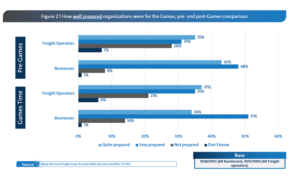
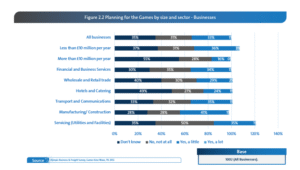
- Around35%of regular travelers changed their travel in some way by reducing, re-timing, re-routing or re-modding their journey on an average weekday during the Olympics.
- Across the two weeks of the Olympics, more than 75% of the London travelling population made some sort of change to their travel patterns as a result of the Games and just 23% continued to travel as normal. Insummary:
- 63% reduced theirtravel
- 28% changed the time of their journeys
- 21% changed route
- 19% changed mode
In total, nearly 50% of all travelers made more than one type of change to their journeys.
2.2 Framing Communication: Hellmann’s “Meal Reveal” AI 2024, UK
Problem:
“Fridge Blindness.” Consumers often have full refrigerators but perceive them as “empty” because they see individual ingredients rather than a cohesive meal. This cognitive failure leads to 4.7 million tons of edible food being wasted annually in UK households alone.
Intervention: Framing Communication: Hellmann’s “Meal Reveal” AI, 2024
Hellmann’s launched “Meal Reveal,” an AI-powered tool (developed with Google Cloud) that allows users to scan their fridge with a phone camera. The AI identifies ingredients and immediately suggests recipes using Hellmann’s as a “connector.”
Mechanism:
- From “Waste” to “Taste”: The campaign pivot shifted the narrative from a Guilt Frame (e.g., “Don’t waste food”) to a Creative Potential Frame (e.g., “Turn what you have into something delicious”).
- Unit Framing: Instead of using abstract environmental statistics, Hellmann’s framed the behavior around Financial Savings, highlighting that the average household could save £780 ($1,000) per year by “revealing” meals they already own.
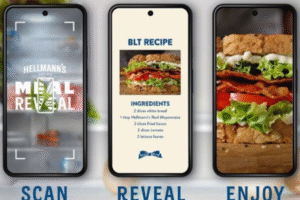
- Reach: The campaign successfully reached 16 million UK households during its 2024 launch.
Engagement: Motivated 71% of surveyed Americans to actively reduce food waste, with over 200 million global media impressions.
- Market Growth: Hellmann’s saw a 3.5 point gain in total market share over the campaign period, proving that “purpose-led framing” drives B2C sales.
- Satisfaction: 80% of users reported high satisfaction in overcoming “fridge blindness,” and 63% adopted the AI-suggested recipes.
- Leveraging Role Models:Mawhiba’s “National Giftedness”, KSA
Problem:
Identifying and encouraging high-potential talent in non-traditional fields requires overcoming social pressures toward standard career paths.
Intervention: Mawhiba’s “National Giftedness”
Leveraging high-profile Saudi innovators and “Vision 2030” leaders as faces of the Mawhiba (King Abdulaziz and His Companions Foundation for Giftedness and Creativity) campaigns.
Mechanism:
Prestige Bias. Individuals are more likely to adopt the goals and behaviors of those they perceive as having high prestige and cultural success.
Impact:
Participation in national talent programs increased by over 40% in three years, with a 200% increase in Saudi students winning international prizes (ISEF) by mimicking the “Innovator” role model.
- Setting New Default Options: South Korea’s “Pay-As-You-Throw”usingRadio Frequency Identification RFID System
Problem:
In the early 2000s, South Korea faced a “Landfill Crisis” a shortage of space for decomposing food waste, which accounts for nearly 30% of their total household waste. Traditional flat-fee systems provided no incentive for residents to reduce waste or remove moisture (which adds weight and cost to processing).
Intervention:
The government implemented a nationwide “Pay-As-You-Throw” (PAYT) model using RFID-equipped smart bins. Every household is issued an RFID card. To open the bin, the user must tap their card; the bin weighs the waste in real-time and charges the household’s account per kilogram.
Mechanism:
‘-The Default Shift: The “Standard” behavior was changed from Unlimited Disposal (where waste cost was invisible and averaged across everyone) to Pay-per-Unit (where waste cost is a direct personal liability).
-Feedback Salience: The digital display on the bin provides an immediate weight and cost reading, creating a “System 1” feedback loop that discourages waste at the point of action.

Impact:
- Recycling Efficiency:As of late 2024, South Korea achieved a staggering 98% food waste recycling rate, a world-leading figure compared to less than 10% in many other developed nations.
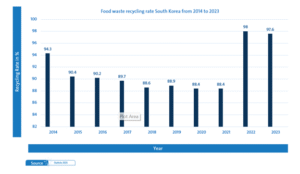
Source: South Korea’s Recipe for Managing Food Waste: From Crisis to Circular Success
- Volume Reduction:In Seoul alone, food waste in Seoul rose from about 155 million units (2018) to a peak of around 162 million units (2020), then declined to approximately 149 million units (2022), returning to near pre-pandemic levels, with individual apartment complexes reporting up to 51% reductions after installing RFID bins signaling improved waste reduction and consumption practices.
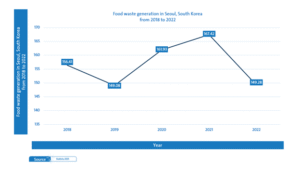 Source: South Korea’s Recipe for Managing Food Waste: From Crisis to Circular Success
- Circular Economy: 100% of the collected waste is now diverted from landfills, with 42% converted to animal feed, 33% to compost, and 16% to biogas providing energy for approximately 20,000 households.
5.2 Saudi Energy Efficiency Program (SEEP)
Problem:
Systemic Energy Inefficiency & Rapid Demand Growth
Prior to the program’s full integration, Saudi Arabia faced a significant surge in domestic energy consumption, threatening long-term economic sustainability. The “problem” was three-fold:
- Technological Lag:Markets were flooded with low-efficiency appliances and vehicles.
- Behavioral Inertia:A lack of public awareness regarding “Rationalized Consumption” (Tarshid).
- Regulatory Gaps:Absence of unified standards across industrial, building, and transportation sectors.
Intervention: Multi-Sectoral “Pulse” Strategy
A multi-sectoral “Pulse” strategy involved three scopes Industry, Buildings, and Transport as follows:
Industry: Steel, cement, petrochemicals, and other industrial sectors.
Buildings: Building envelope, ACs, white goods, lighting products.
Transport: Light Duty Vehicles (LDVs), and Heavy Duty Vehicles (HDVs).
SEEC launched an integrated suite of interventions designed to nudge every layer of Saudi society toward efficiency:
- Regulatory Pillar:Implementing over 26 technical specifications for products and buildings.
- Incentive Pillar:Direct subsidies (e.g., the 1,000 SAR Estibdal rebate) to lower the barrier for efficient upgrades.
- Educational Pillar:Launching the“Ltabqa” (To Last) campaign and the “Virtual Efficiency Home” to simulate and reward efficient behaviors.
Mechanism:
The program’s high impact is driven by specific psychological levers:
- Availability Heuristic (Ltabqa Campaign):By launching 31+ national campaigns, SEEC keeps energy efficiency “top-of-mind.” Constant social cues (on TikTok, TV, and billboards) make efficient behavior the “mental shortcut” for the public.
- Gamification (Virtual Efficiency Home/Taqa Kids):SEEC uses interactive “digital twins” of homes to reduce Cognitive Load. Users learn that “Setting the AC to 24°C” is a simple, rewarding win rather than a complex technical sacrifice.
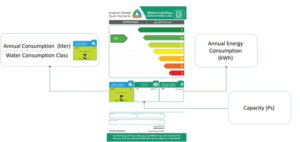
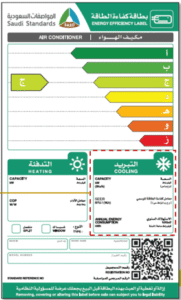
- Choice Architecture (Energy Intensity Labeling):By mandating Energy Efficiency Labels on all appliances and vehicles, SEEC uses the Anchoring Heuristic. The label forces a comparison at the point of purchase, anchoring the consumer’s decision on long-term savings rather than just the initial price tag.
Energy Efficiency Label: Dishwasher
Energy Efficiency Label: Air Conditioner
The Impact: High-Impact Results (End of 2024–2025)
- National Resource Recovery:Achieved a cumulative primary energy saving of 662,000 barrels of oil equivalent (BOE) per day.
- Market Transformation:Successfully achieved a 91% market compliance rate with energy-saving specifications.
- Industry Empowerment:Licensed over 58 energy service providers, creating a self-sustaining private sector for efficiency.
- Cultural Shift:Integrated energy conservation into the national identity via the “Ltabqa” brand, moving sustainability from a policy goal to a daily Saudi habit.