
Close

Saudi Arabia is implementing ambitious national transformation programs that can succeed only
if they reach key social, economic, and environmental objectives. Traditional policy making,
incentives, rules, and regulations alone will not be enough to achieve many of these objectives.
This is because people have “cognitive biases,” natural tendencies to resist change, even against
their best interests. To counter such biases and improve the efficiency of new policies, many
countries are integrating behavioral insights into the policymaking process.
Behavioral science can provide policy makers with a better understanding of why people behave
in these ways and help them design tools to change these behaviors, there by enriching the
economic models in place.
According to Strategy&, behavioral interventions could possibly be applied to 12 objectives in
these plans considering structural levers used to achieve them, as well as the success of
behavioral interventions implemented globally to achieve similar objectives.
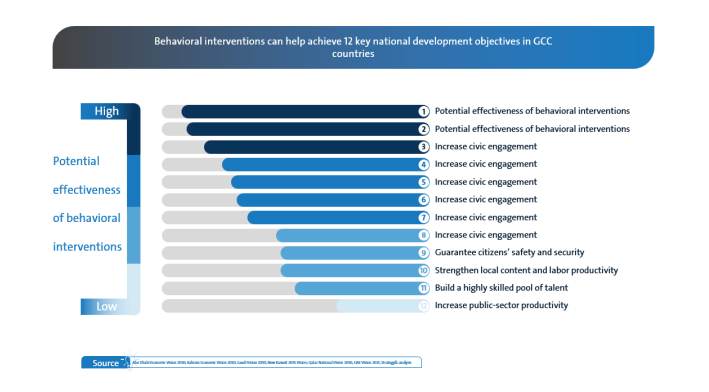
By applying behavioral interventions in the right places, the country can effectively achieve the
key objectives outlined in their national transformation plans.
Behavioral tools should be transparent and not misleading, back out, and should aim to improve
people’s welfare.
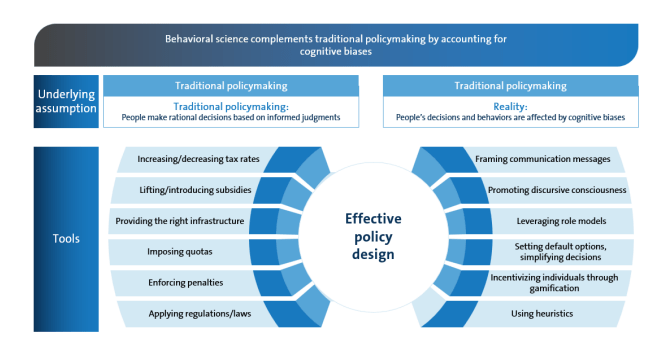
The most common examples include:
• Framing communication messages.
Communication campaigns leveraging deep cultural and psychological insights are key to
effectively enabling the desired change.
• Promoting discursive consciousness.
Discursive consciousness is what a person is able to say or articulate verbally about social
conditions. Designing interventions in schools (updated curricula, training sessions, field trips)
and special content segments on media channels educates audiences on intended behaviors.
• Leveraging role models.
Selecting brands or public personalities (athletes, artists, and political leaders) or creating model
fictitious characters to champion a desired behavior can encourage more people
to follow suit. Similarly, initiating peer comparisons can motivate change by triggering a sense of
pride or guilt
• Setting new default options.
Using regulation to position a desired outcome as the default option (e.g., making a green plan
for household electricity consumption the default choice) increases individuals’ participation
without restricting their freedom of choice.
• Incentivizing individuals through gamification.
Giving individuals opportunities to earn achievements when they engage in a desired behavior,
through personal goalsetting or competitions on social media, for example, boosts their sense of
self-efficacy or normalizes the target behavior socially.
• Using heuristics.
Creating mental “shortcuts” like catchphrases, songs, visual cues, and so forth, can speed up
people’s decision-making process and help them adopt a satisfactory solution close to the desired
behavior (e.g., people easily remember the “a 5 day” recommendation to eat the right amount
of fruits and vegetables, although this does not necessarily mean they follow it).
The case studies below illustrate framework for the aforementioned behavioral tools:
1. Incentivizing individuals through gamification: STC Qitaf Program, KSA
Problem:
The “Commoditization Trap”, where telecom services are seen as a basic utility, leading to high
churn rates as customers switch providers for minor price differences.
Intervention: The “Value-Exchange” Ecosystem: STC Qitaf Program The Qitaf program, a massive loyalty ecosystem that integrates points into a “burn and earn”
network with hundreds of external partners (retailers, airlines, and food & beverage).
Mechanism: The Endowment Effect & Mental Accounting. By allowing points to be spent at external partners
like Tamimi Markets or SAUDIA Airlines, STC shifts the points’ status from “corporate credit” to
“liquid currency.” Once users accumulate significant points, they perceive switching providers as
a tangible financial loss rather than just a service change.
Impact:
With over 10 million subscribers and a growth rate of 10% annually, STC has successfully used
Qitaf to maintain a dominant market share. High redemption rates confirm that the program is a
primary driver of retention for high-value postpaid and landline segments.
From inquiry to booking
Before project completion
During the launch phase
In sales velocity
“Jewar” new direction resulted in a clearer and more professional brand image that reflects its vision of delivering real estate projects based on unique concepts and targeting discerning audiences. The communication strategy developed by Align transformed scattered efforts into a systematic, institutionalized practice built on a clear narrative, consistent identity, and initiatives tailored to specific segments.
This approach enhanced the efficiency of marketing and communication operations by focusing efforts on targeted, high-impact channels and aligning messages with the right context. As a result, Jewar was able to solidify its position as a reliable and distinct developer within a competitive landscape ,capable of building long-term relationships with its audiences based on trust and a unique customer experience.